
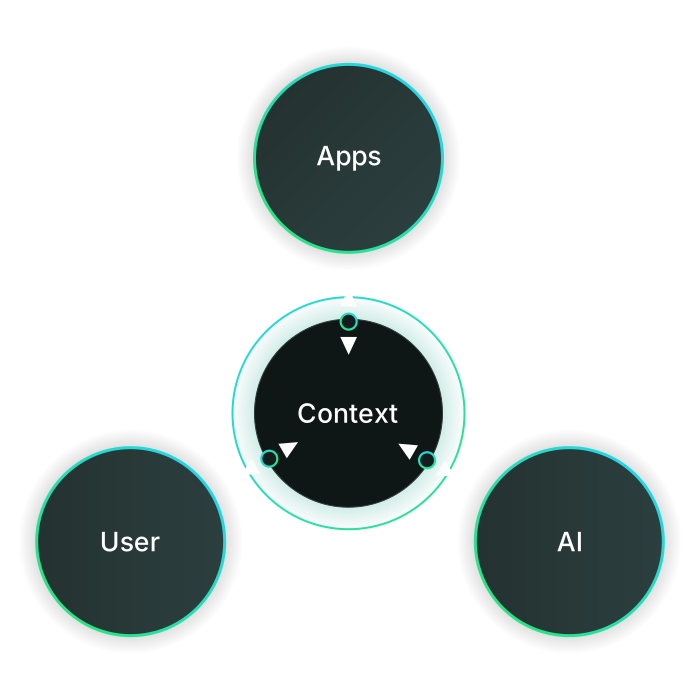
ānbāsan is built on a new paradigm for work: information is not merely collected, but transformed into context — enabling users and AI to work together more efficiently, while significantly reducing token usage.
Knowledge isn't the problem — missing context is.
Data is scattered across emails, notes, appointments, and tasks. Before your AI can get started,
you're the one left pulling it all together.
Without CDW
01
You want to give the AI a task
02
First search for a document – context is missing
03
Another document, that's also important
04
Upload everything
05
Explain the background
06
And only then the task you actually care about
➜
With ānbāsan
➤
01 — Collect organically
Emails, notes, appointments, and tasks flow automatically into your context as you work — no pre-sorting required.
02 — Organize automatically
The Context Manager recognizes relationships, assigns data via auto-assign, and forms topic clusters. You always have the final say.
03 — Use via MCP
Via the open MCP standard, every AI directly accesses the right excerpt of your context — precise, without copy-paste. And saves tokens in the process.
No CDW
100 %
With CDW
45–90 %
Instead of sending along everything that might be relevant, each request receives only the right excerpt of its context. This reduces context input token usage by 10–55 % depending on the use case.
And because the context is right from the start, your AI doesn't just need fewer follow-up questions to reach the right answer — it gets to the point faster. That also saves output tokens and entire iterations — overhead that otherwise silently accumulates in every conversation.
Actual savings depend on data situation, model, and use case.
Curious to see ānbāsan live or have questions? Just reach out. Want to dive deeper first? Explore all features here.
Context-Driven Work describes how you work. The Context Manager makes it possible.
The Concept: You no longer have to manually structure your data for AI use. Context emerges organically as you work.
The Technical Solution: The Context Manager automatically organizes information, builds topic clusters, and keeps your context up to date.
The Context Manager provides your context as a service — including through MCP servers that can be used directly by any AI tool.
The layer where your context lives — between application data and AI, accessible from both sides.
AI-Tools & Apps
Access via MCP
Context-Layer
Maintained by the Context Manager (CM)
App-Data
...
MCP (Model Context Protocol) is an open standard that enables AI applications to access external data and tools.
Today, AI agents operate on fragmented data spread across emails, notes, task managers, and countless other tools.They see pieces of the puzzle, not the whole picture — and poorer results reflect that.
AI doesn’t know the context behind the data. The result: incomplete, generic answers — and AI potential left untapped.
Users are forced to manually piece together data from every app before giving it to AI — wasting time on work that should be unnecessary.
The less precise the context, the more irrelevant data is processed — and the more tokens are wasted.
Most apps store information. But they don’t connect it in a meaningful way. And that’s exactly where productive AI fails. ānbāsan turns scattered knowledge into a usable work context—so AI doesn’t just respond, but truly helps.
Emails, notes, documents, files, and tasks exist separately from one another. Users hold the connections in their minds—AI does not.”
The answer is Context-Driven Work (CDW): Context doesn't emerge later through organizing and cleanup. It emerges organically as emails, notes, meetings, and tasks are created throughout the normal flow of work.
Learn more about the Context Manager.
All relevant information in one place instead of being scattered across five different apps. Easily accessible through contextual navigation.
No data rooms. No manual organization. Your context structures itself automatically based on your rules. MCP provides seamless access to context — without the need for separate data repositories.
AI works with complete, relevant context instead of isolated fragments.
Targeted context reduces input token usage. More accurate responses mean fewer iterations and lower output token consumption.
Ready for a live demo or do you have questions about ānbāsan? Then get in touch with us right away! Or if you’d like to learn more first, read more about Context Management here.”
Ready for a live demo, have questions, or want to learn more? Contact us — or explore Context Management in more detail first.
If you’d like to stay up to date on new features and insights into the paradigm of context-focused work, sign up for our newsletter.