
ānbāsan - work with | in context
Context Management for Users and AI
How information can be brought together, understood in context, and used effectively — for improved organization, more efficient AI workflows, and less effort in daily digital life.
// What it's about
AI requires new tools
Digital work does not fail because there is too little information, but because information is too dispersed and managed without meaningful relationships. Emails, notes, documents, calendar data, tasks, files, and AI chats together create a valuable information space — yet this space is often highly fragmented and difficult to read or use as a coherent whole.
Context management, through a context-based working model paradigm, starts exactly there. This model describes an approach in which information is not only stored, but, above all, its relationships are captured consistently from the moment it is created. The goal is not order for its own sake, but the best possible usability in everyday work — without adding extra effort. When data is in the right context, it can be understood faster, processed more efficiently, and handed off to AI systems more effectively.
This page brings together the key aspects of this approach. It explains how context management and context-based work relate to productivity, organization, AI tools, app integration, and token usage. The result is a coherent picture that is meant to be understandable both technically and practically.
// What it involves
Working with Context Management
When someone reads a note, they immediately ask about the context: What was it about? What came before? What follows? What else is connected to it? Good context management answers these questions.
Information in context
A single piece of information becomes far more useful once it is clear what it relates to. Context defines that connection.
Connections across apps
Rather than treating data as isolated entries, it is connected across apps. This makes knowledge easier to access and saves a significant amount of time.
Context-based work goes one step further by keeping new data in context from the start. It treats information not as isolated pieces, but as part of a connected whole.
This is especially important for AI-assisted work. A model that sees only one sentence can respond only in general terms. A model that knows the background, the goal, and the relevant connections can help much more precisely. That is why context is not an extra feature, but the foundation of useful AI.
// Turning data into context
Connecting data from apps
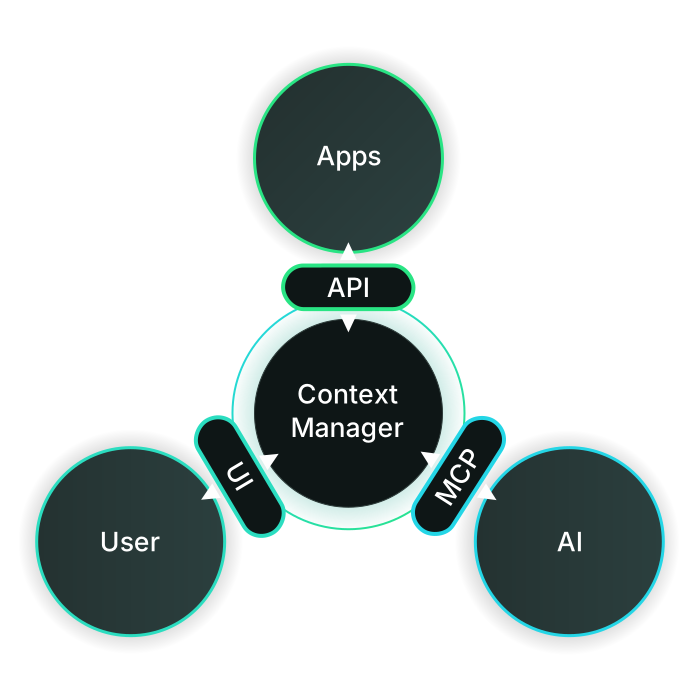
Most users today have to work across many apps and systems. Information is created in email clients, project tools, note systems, file storage, and chat applications. Each app manages its own data separately from the others. Bringing all of these parts together can make work more efficient, and when combined with AI applications, it unlocks enormous new potential.
Context management and context-based work promote and enable exactly this connection. They ensure that content does not just exist side by side, but consistently forms a shared picture. An email can refer to a meeting, a task can link to a document, and a note can capture the decision that emerged from several conversations.
As a result, a loose collection of data across apps becomes a connected workspace: context. This saves time when finding relevant information and prevents misunderstandings. When you immediately see how things are connected, you no longer have to reconstruct or infer the relationship — you can work faster with and in context.
// Practical benefits
One workspace instead of individual tools
Information is not just stored; it is contextualized. This creates a system that no longer views content and data in isolation, but as elements of a larger, connected whole.
Clear structure
Data is kept connected, making the relationships between it easy to follow.
Less searching
When information is properly connected, it can be found faster and used more effectively in practice.
Better AI usage
By keeping information in context, the answers come faster and fewer tokens are needed — which makes the approach economically and ecologically smart.
Live demo, questions, or ready to go deeper? Contact us!
// What Context Management achieves
More productivity in everyday work
Productivity does not come only from faster input, but also from fewer interruptions. Whenever a user has to switch between apps, gather content, or recreate context, time is lost. A good context system and a context-based way of working reduce this friction in a very noticeable way.
Context grows organically and automatically over time, following the user. New elements, such as a new email, can be automatically assigned to the right context by the system. With the right context, all relevant information is immediately available and allows the user to work faster — also because AI has access to the same context when it performs a task.
Work becomes less fragmented and noticeably smoother. You do not have to start from scratch every time, but can build on existing information.
In addition to saving time, the quality of AI responses also improves. Context acts as a filter, providing a preselection of relevant data that AI can access for its task. This reduces the risk of misinformation, saves tokens, and delivers the desired answer faster and with less effort.
// Creating context
Organizing data
Data organization is often reduced to folders or tags. Folders and tags are useful, but both follow only a limited storage concept. Context management goes beyond that.
The key difference is the creation of both implicit and explicit connections. This does not happen in a rigid way, but involves the user as well — regardless of how the system processes things in the background, separate from the user. Information is not simply stored in one place; it is consistently embedded in a structure that makes its context usable. Every piece of information or record can be relevant in different contexts, without needing to be duplicated.
This is especially helpful when new data needs to be added to the context over time. A system with a strong context structure remains easy to manage and clear, even as the amount of data grows. Over time, context organically grows into a valuable knowledge space.
// 10–55% fewer context tokens
Token consumption and AI efficiency
Context-driven work prioritizes data relationships. Once a context is defined, it acts like a filter: every search is performed only within that context instead of across the entire dataset. Relevant preselection takes place before any data is loaded, meaning fewer input tokens are required. In a statistical study using our own data, we reduced context input tokens by 10% to 55%, depending on the use case.
How much tokens can be saved depends on the application scenario. The overview below categorizes typical use cases from narrowly focused compliance questions to exploratory research.
The context filter offers another important advantage. Traditional search systems rank data by similarity and pass only a limited number of the highest-ranking results to the AI. Relevant information that falls just outside this cutoff can easily be overlooked. Because context management narrows the source data in advance and filters out obviously irrelevant information, this problem occurs less frequently keeping the truly important information in focus.
The benefits are not limited to input tokens. Output tokens are generated in smaller numbers, but they are four to five times more expensive, making efficient context equally valuable. More input does not automatically produce better output. When a model receives exactly the right context without unnecessary noise, its uncertainty decreases. It asks fewer follow-up questions, repeats itself less often, and produces shorter, more precise answers.
"Context management saves tokens on both sides. It filters the input before data is loaded and improves the output because the model has less noise to compensate for."
// Basics
Technical basis
Technically, context management works on several levels. First, information from different sources must be synchronized. Then, it is assigned to a shared context — either automatically by the context manager or by the user. Finally, these relationships are stored or updated so that both users and AI can access them at any time.
The separation between raw data and context is especially important. Raw data is the original content. Context is the relational handling of that content. This separation keeps the system flexible and lightweight, because information does not need to be stored multiple times.
Users and the system can both create and manage context. But they must never work against each other. That requires transparency and a clear hierarchy: the user always remains in control and makes the final decision, while the system only assists beforehand. When the system acts, that action must be fully traceable so the user can trust it.
// Example
How simple it is in practice
01
Incoming
An email, note, or task is newly added to the system.
02
Assignment
The system identifies which process fits which topic, or creates a new context when possible.
03
Connection
All interactions and follow-up actions remain connected to this context.
04
Usage
AI and users work in and with the same context.
This model is especially useful because it does more than store information. It actively supports users in creating and managing context, reducing their workload in the process. At the same time, it allows context to be used immediately, without any additional steps.
// Example
Some scenarios
Customer message
A new message is linked to a customer project and related past messages. The reply can draw on previous responses and build on all existing information.
Project note
A note documents a decision. It is connected to all relevant meetings, tasks, and correspondence — across different projects. This makes it easy to understand how the decision took shape.
AI question with context
A short question is enough because the system already knows which information belongs to the case. No searching is needed — just copy the context and start the chat in context. Everything created in the chat is automatically part of the same context as well.
// In a nutshell
Summary
Context management combines technical structure with practical value. It helps organize information more effectively, connect data across apps with clear relationships, and make AI both better and more efficient. A context-based way of working simplifies digital work and makes it more efficient and more pleasant for users by removing unnecessary administrative tasks. This approach is not only relevant for special cases, but interesting for a broad range of users with diverse workflows.
When a system understands context, there is less friction. That is what drives higher productivity through data organization, AI use, and more efficient information handling when working with and in context.
// Contact
Ready for the next step?
Live demo, questions, or ready to go deeper? Contact us!