

How context-driven work transforms data into usable AI context

How context-driven work transforms data into usable AI context

Abstract graphic of data relationships in the cloud that provide context for work with AI.

How context-driven work transforms data into usable AI context

At the heart of modern information systems lies the question of how to ensure that users can access the information relevant to them at precisely the right moment. Technologies such as Retrieval-Augmented Generation (RAG), semantic search, vector databases and hybrid retrieval methods provide innovative solutions for this.

However, it is often overlooked that the reverse process – namely collecting, structuring and evaluating information within the system – is at least equally important. This raises questions about how data enters the system, how its relevance is determined, what relationships exist between individual items of information and who ultimately oversees these decisions.

Context-driven work: the view from another perspective

The technical implementation of providing context today is mainly shaped by pragmatic methods and the available technical possibilities – such as uploading documents, synchronizing folders and connecting different data sources via connectors. These processes are then followed by indexing and vectorizing, which make content searchable.

However, this approach initially creates only a loose collection of information, which does not yet form a genuine context. Control over which data is classified as relevant in which context remains largely beyond the user’s control; in fact, users are forced to manually transfer the contents relevant to them into suitable data spaces and structure their context independently.

Automation as an important component, but not as the sole solution

Automation methods such as clustering can help to structure large volumes of data and make semantic connections visible. Nevertheless, these methods reach their limits, as they can recognize similarities and patterns, but do not necessarily capture the complete picture of the information.

A key reason for this is that only a part of reality is ever represented in a system’s memory, and the deeper meaning as well as the connections between data often remain hidden. While automated processes contribute to increased efficiency, final assessment and classification of information remains a task that the system alone cannot necessarily perform satisfactorily.

This is where the human user comes back into play, whose knowledge, experience and understanding of the relationships extends far beyond what a technical system can represent. While automated methods rely on statistical analyses and similarities, it is the human being who can deliberately establish and evaluate the relevant connections between data. They not only know the objectives and history of a project, but are also able to recognize and identify relationships that are neither stored nor visible to the system.

The relevant context is not found solely in the stored data, but above all in the knowledge and experience of the users. Although systems can take on numerous tasks and facilitate everyday work, user expertise remains irreplaceable when it comes to understanding and effectively using context.

Only by incorporating the user as a central authority does a dynamic and growing network of information emerge. The user becomes the critical variable — one that cannot be replaced or optimized out.

Incorporating the user as a key authority

In everyday work with artificial intelligence, a recurring pattern emerges: for every new task, a suitable tool is opened, relevant documents and content are uploaded and the query is formulated – as soon as the context changes, this process begins again, with the user having to manually enter the new context.

This cyclical effort illustrates the limitations of conventional, data-space-oriented working methods and underscores the need for a context-driven approach that sees the relationships between data as the central element. Instead of organising data merely in folders, files or by tags, an organic network of relevant information is created right from the start through the involvement of the user, which grows and evolves continuously alongside ongoing work. Particularly in long-term projects, such as a client assignment, a context can develop over months, encompassing all key decisions, documents, discussion outcomes, as well as open questions and tasks, all interconnected.

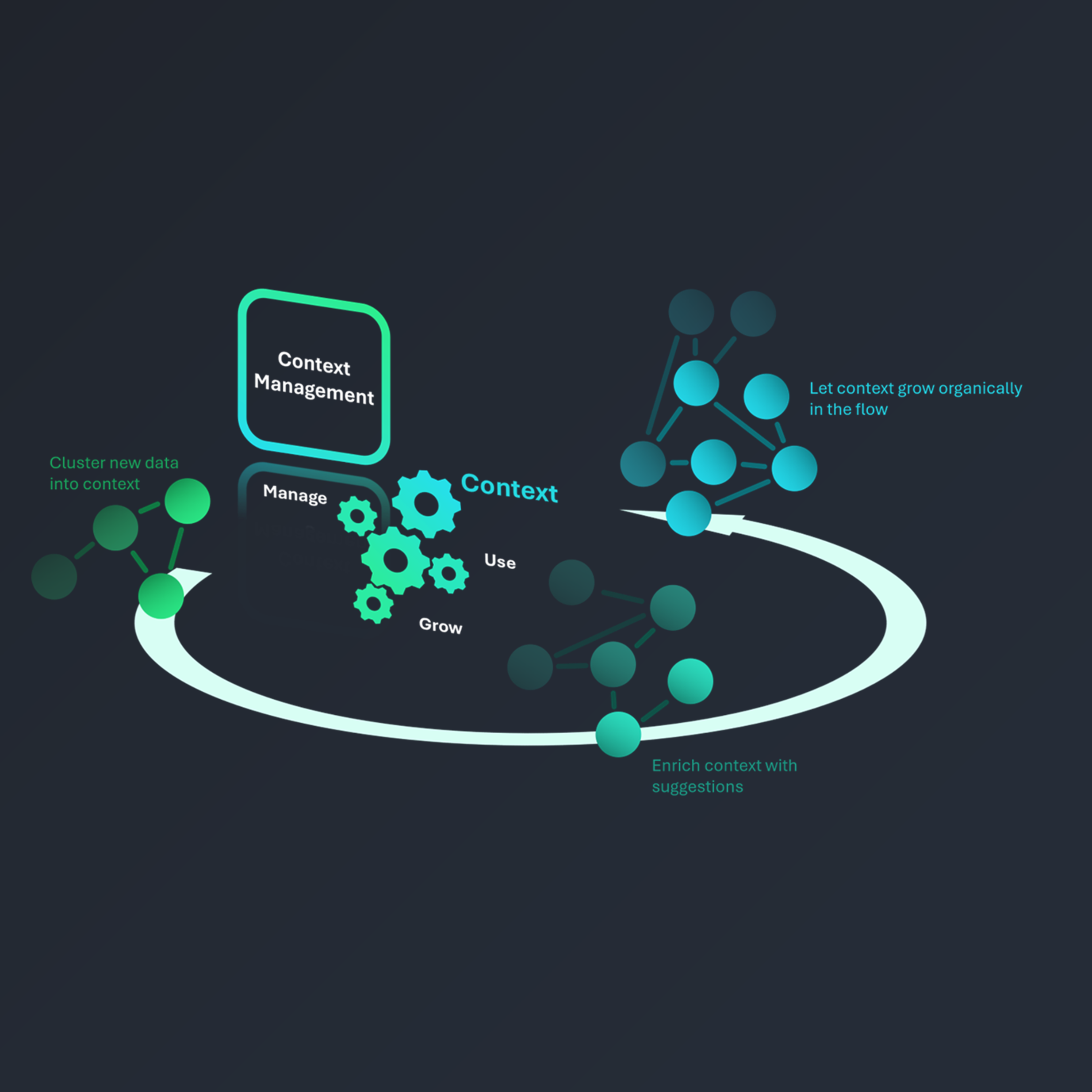
Context Manager – replaces the organisation of data in folders, files or by tags with a continuously and organically growing network of relevant information.

The crucial difference from previous working methods is that context is no longer static and isolated, but develops organically and reflects the user’s personal assessment of the relevance and connections between individual data points. The laborious manual assembly and linking of documents and information is no longer necessary, because relationships and meanings are captured directly and continuously within the context.

"Context is meant to grow organically and naturally over time and through working with data."

A Context Manager as an indispensable tool for the user

A so-called context manager represents a central tool that combines the advantages of automatic analysis with the expertise and individual assessments of the user.

Direct working within context

The primary and most important function is that new elements such as files, notes, tasks or emails can be added directly to the relevant context object. Implicit connections between the data are also leveraged, significantly facilitating the user's work and at the same time improving the quality and consistency of the entire context. This creates a working environment that is efficient, flexible and dynamic.

Auto-clustering and intelligent suggestions

Automatic analysis enables large and complex datasets to be efficiently structured by identifying relevant connections and providing the user with an overview of the most important thematic groups. The user can actively shape these suggestions and thus ensure that the formation of context reflects their perspective.

Suggestions for expanding context

Building on the context already known, the system suggests additional content, such as thematically related documents, messages, tasks or relevant notes. These intelligent recommendations relieve the user from searching for additional information and provide a solid basis for decisions, enabling a targeted and in-depth expansion of context.
A context manager thus ensures that data is not simply archived, but develops organically and steadily into a comprehensive context that can be continuously expanded and maintained. It actively supports users in creating and updating context, and enables them to use it directly and intuitively in everyday work.

Through the combination of technical automation and human expertise, a flexible, growing network of information is created, optimally tailored to the needs and goals of users, and enabling lasting improvements to work processes, especially in connection with AI usage.

Conclusion

Context-driven working places the user at the centre – and transforms a mere collection of data into a living knowledge network that can be accessed quickly and efficiently. The context manager is the tool that makes this transformation possible.

Own additional resources
Share

Context-driven work is the future

Context-driven work is the future

Abstract graphic of data relationships in the cloud that provide context for work with AI.

Context-driven work is the future

The next stage in improving AI productivity is not more elaborate prompting or ever more powerful models, but a system that makes the right context available at the right time. Right means not simply loading a set of matching items from a large information pool; it means finding the pieces that fit the situation and reflect the user’s current knowledge.

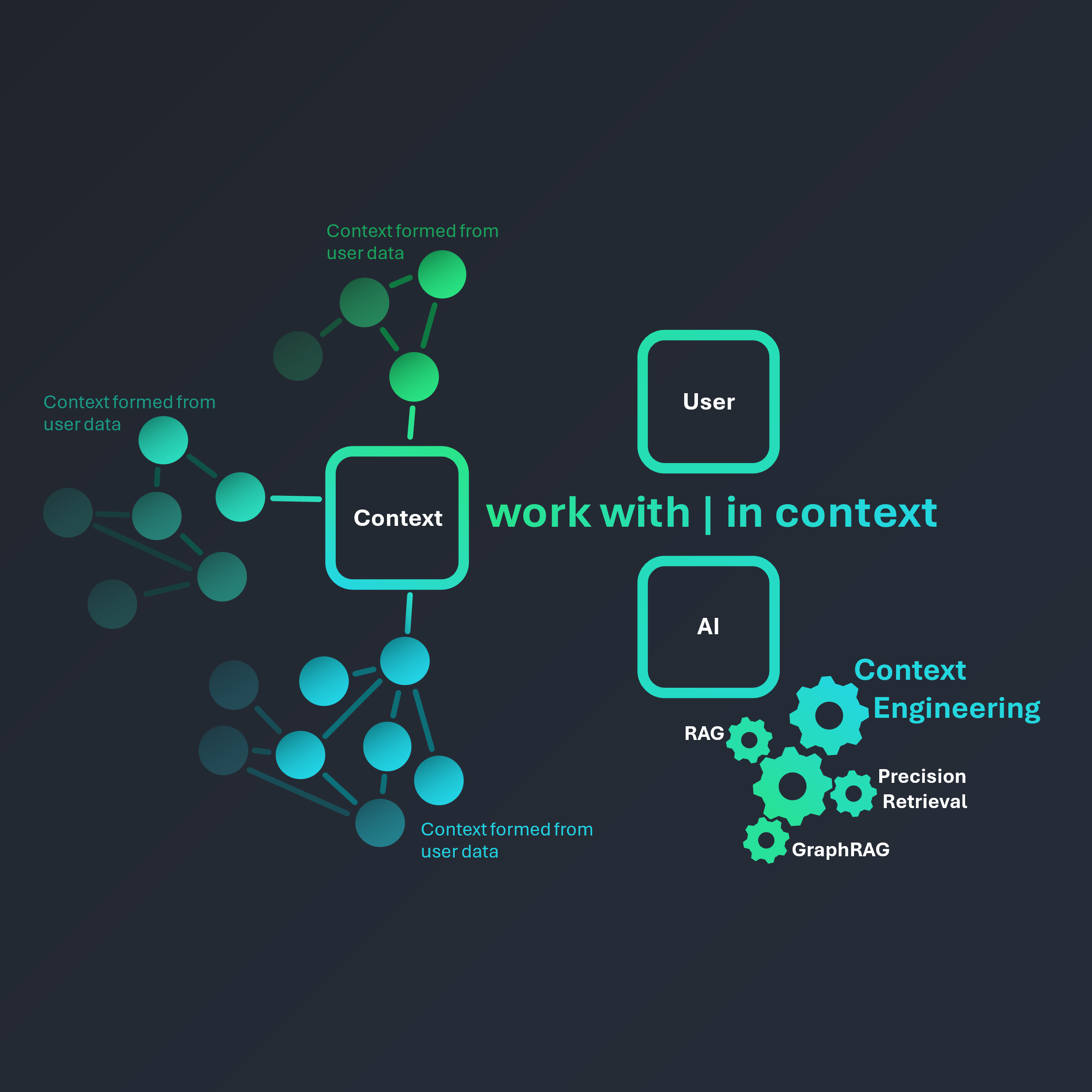
That is why context-based work, RAG, precision retrieval, GraphRAG, and context engineering are becoming more important. They improve the quality of decisions, answers, and workflows because they do not just store information; they turn it into something even more actionable.

Why context is the real challenge

Many problems in knowledge work and AI look like model problems at first glance. In practice, the cause is often elsewhere: the relevant context is missing, scattered, or presented in an unsuitable form. Anyone who only sees fragments—whether a user or an AI system—will inevitably produce weaker or even wrong results.

The same is true for teams and AI systems alike. A team makes better decisions when background, dependencies, and goals are clear. A model gives better answers when it receives exactly the information that fits the task at hand—not too much, not too little, and well structured. In both cases, context is the real lever, not raw compute power.

What RAG solves

Retrieval-Augmented Generation, or RAG, adds external information to a language model at runtime. Instead of relying only on what was learned during training, the system retrieves relevant documents or knowledge sources before answering. This reduces hallucinations and anchors responses more strongly in real, current sources.

What matters is not just retrieving text, but selecting the right text. When retrieval and context transfer work well, answer quality improves significantly. When they fail, the model may still be fed with data—but not with useful context. RAG is therefore less a model question than an information-quality question.

Precision Retrieval: the right passage, not the entire document

Classical RAG often works at document level: a document is deemed relevant based on a blended embedding and then passed on in full or in large sections as context. The problem is noise—if a long text contains only a small amount of relevant content, the rest consumes valuable context window space without adding value.

Precision retrieval solves this with fine-grained, chunk-based retrieval. Texts are split into semantically meaningful sections, known as chunks, and mapped into vector space via embeddings. For a query, not whole documents are returned, but only the chunks whose embeddings are closest to the request. The model therefore receives not more context, but the right context.


The practical difference is substantial: less irrelevant material in the context means fewer distractions, lower token costs, and better answer quality. Precision retrieval is not a separate architecture next to RAG, but a consistent evolution of the retrieval step—from “find the document” to “identify the relevant passage.”

The better context is organized, the less models need to guess—and the better answers, recommendations, and automations get.
How GraphRAG takes things further

GraphRAG builds on RAG and adds the dimension of relationships. Classical RAG asks: Which document is most similar to my query? GraphRAG goes further: How are the retrieved pieces related to one another? To do this, it combines semantic similarity search with a knowledge graph: a structured network of entities and their connections.

That matters because many questions cannot be answered from a single isolated passage; sometimes they only make sense through relationships. Put simply: RAG delivers content, GraphRAG delivers structure. For complex domains, internal knowledge bases, and agentic workflows, that is a major step forward.

The trade-off is real: building and maintaining a knowledge graph requires schema design, entity extraction, and the right infrastructure. GraphRAG is therefore not a universal replacement for classical RAG, but a targeted extension for use cases where relationships and multi-step logic are essential.

Related Video from IBM Technology

YouTube – How RAG, GraphRAG, and Context Engineering Improve AI Performance

Context Engineering as the overarching discipline

Context engineering goes beyond retrieval. It refers to the craft and technique of designing an AI system so it has the right state at the right time: the right documents, metadata, tools, and memory states. The question is not only “Which file is available?” but “Which information space makes sense for this task?”

This is an important shift away from classical prompting. A useful analogy is the boundary condition in mathematics or physics: the task is given by the user, context engineering defines the boundary conditions, and the AI solves within that frame. Prompting formulates the question. Context engineering defines the space in which it should be answered.

As AI applications grow more complex, context engineering becomes increasingly central — because quality doesn’t come from the model alone, but from the interplay between model and context.

Why context-driven work is the future

Context-driven work means treating information not as a loose collection, but as a coherent whole from which the structures emerge that GraphRAG formalizes as a knowledge graph. The practical effects are immediate: less time spent searching and reconstructing knowledge, less information loss when switching between apps, more clarity about connections and dependencies, and less effort assembling context again and again.

For users, that means less fragmentation and more ability to act. For AI systems, it means more robust retrieval, more reliable answers, lower token costs, and better automation. What unites both perspectives—the user side of knowledge work and the machine side of processing—is the shared context they work with.

What this means for ānbāsan

ānbāsan addresses this problem by focusing on a context-driven way of working. The app does not just collect information; it shapes context. That is more than note-taking, more than task management, and more than a place to store things. It is about connecting scattered fragments without extra effort so they become a usable working context that stays accessible, understandable, and reusable.

In doing so, ānbāsan acts as a layer between unstructured data and AI systems. The same structure that helps people make better decisions is also the foundation that allows AI systems—whether with RAG, GraphRAG, or agentic workflows—to perform better. Context is the shared language of users and machines.

Mind the Human in the Loop

All of these technologies—RAG, precision retrieval, GraphRAG, context engineering—solve the technical problem on the AI side: How does the right knowledge reach the model at the right time? But they assume that the underlying data is already organized in a sensible and correct way. In practice, that is rarely the case.

Today, information is spread across different apps, files, chats, and documents—without internal links. Anyone who wants to provide an AI with context must first assemble it manually, copy it together, or paste it into a chat, often more than once. The key relationships between data objects often exist only in the user’s head, nowhere else.

Context-driven work solves that problem. The idea is that every data object brings its context with it intrinsically—meaning it does not have to be assembled later, but is managed in situ together with its relationships to other objects. The user decides what belongs together and what matters. They actively shape the context with their expertise—not the system, although the system supports the user in the background.

This user-managed context becomes the actual foundation from which AI systems can draw. RAG and precision retrieval no longer filter from an unstructured mass of data, but from an already meaningful network of information that reflects user expertise about relevance and connection. The user gives the system something no AI can have: the full picture.

Conclusion

Context is the common denominator of good knowledge work and good AI. The better context is organized, the better the decisions—and the better the results, with less effort.

Further Reading: ānbāsan as Context Engine for users and AI

Additional resources
Share